


Access to healthcare for all
Access to MRI for all
MRI is the most versatile medical imaging modality, yet 90% of the world does not have access to MRI.
(World Health Organization)
Meet Open Imaging Insight.
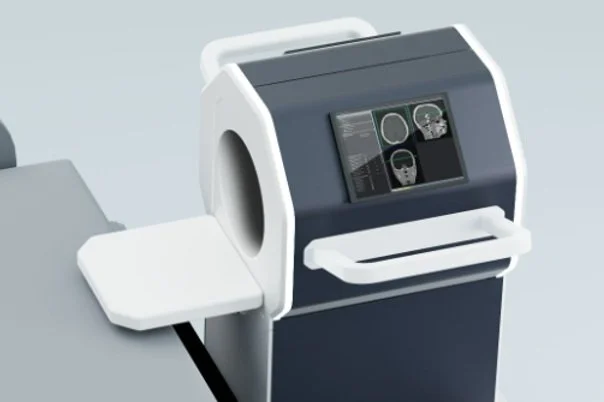
Open Imaging’s solution to making MRI more accessible for all. Built to be mobile, OI Insight can be brought to clinicians and patients wherever they are.
Built on a light weight array of permanent magnets that generate a low magnetic field (”low-field MRI”), OI Insight has been designed for brain imaging to detect various conditions such as stroke and traumatic brain injury at the earliest (and often most critical) stages of clinical diagnosis.
Unlike conventional high-field MRI found in most hospitals today, our system is transportable, has lower installation, operating and maintenance costs, and requires no special building facilities to install.
Bringing MRI to underserved groups
Imagine you live on a remote island with limited infrastructure, where you would have to travel for hours by motor vehicle, boat, and plane to get to the nearest city with an MRI. With OI Insight, we seek to provide underserved communities with ready access to MRI at even the most basic public health centers.
Shorter time to clinical diagnosis
Unlike conventional MRI, OI Insight requires very few dedicated facilities, is easily transported, and can be powered through a normal socket. In medical situations where an MRI scan is urgently needed, OI Insight can be quickly readied for use to make a clinical diagnosis or initial assessment.
Reducing financial & capacity burden on patients and health workers
For many people around the world, traveling to a central hospital to get an MRI done can be a financial burden. Not to mention the potentially long wait due to the number of patients and the limited availability of radiologists and MRI facilities. With OI Insight, our aim is to reduce these burdens by providing local clinics and hospitals MRI units that can be operated by a wider range of health workers.
Reduced transport risk for patients & improved patient comfort
No longer will patients have to endure a potentially risky transfer to a fortified and claustrophobic space. OI Insight can be transported to the patient, requires no dedicated scanner room or bed, and has fewer contra-indications compared to conventional MRI. This allows reduced patient preparation time, and patients can safely stay beside their family and caregivers while they receive their scan.
Emphasis on openness
We believe that advancing access to healthcare for all is the collective responsibility of all actors in the healthcare ecosystem. For this reason, we value close collaboration with clinicians, research groups, governments, and universities, and will open-source some of our technology upon consultation.
Benefitting stakeholders
We want our product to not only benefits end-users, but also locally based communities and stakeholders. Making MRI more accessible does not only mean delivering the product to clinics, but also building local knowledge and capacity on MRI, which we will strive to do in collaboration with our partners.